
Chinese medicine is a comprehensive system of medical care which has been in constant widespread practice, research, and refinement for over 2,000 years. It can effectively treat most health conditions, and is very safe when practiced by practitioners who are fully trained and licensed. The training program is rigorous, much like that of Western medical training.
There are many modalities within Chinese medicine, which are united by a common understanding of the causes and nature of disease, and the ultimate goal of reactivating each person’s inherent healing capabilities.
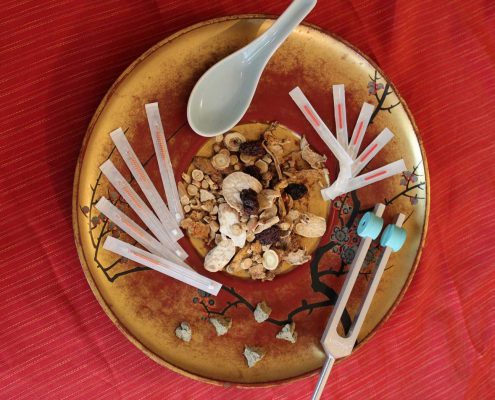
The theoretical foundation of Chinese medicine is quite different than the Western understanding of the body in health and illness, however, Chinese medicine practitioners receive extensive secondary training in Western physiology, pharmacology, and more. The two systems can be employed harmoniously, when appropriate.
Find out more about what to expect.
More information about conditions treated by Chinese medicine is here.
The modalities I offer include:
Acupuncture
Acupuncture is the insertion of sterile, single-use, very fine needles into specific points on the body which have been determined over thousands of years of study and refinement to adjust movement and circulation within the body and to regulate life processes. The needles are usually retained for a short period of time, and very commonly generate a feeling of deep relaxation.
In addition to addressing the principal concerns a patient has, acupuncture often can produce changes in older health problems, and may sometimes generate emotional releases. The needles may be placed directly in the area on which we are focusing, and are also commonly used in other areas to enhance the local work. There are many different styles of acupuncture, and different conditions may call for more or less stimulation of the needles, but most people do not find it to be painful. Sometimes a stronger sensation is felt at first, but it is usually described as “heavy,” “strange,” or something other than “painful.” Adjustments can always be made if there is any discomfort. I work to ensure that you are relaxed and at ease, and I do my best to answer any questions you may have.

I enjoy working with those who have never had acupuncture before, and for patients who do not wish to be treated with needles, I offer alternatives, such as cupping, moxibustion, bodywork, and a Japanese treatment style that does not insert needles, and is also great for children. Please talk to me about any concerns or fears you may have so that together we can create the most effective plan that will best help improve your condition while ensuring your comfort.
Herbal medicine
Chinese herbalism can be used to help any sort of disease, and is, in fact, much older than acupuncture. Herbs are combined in specific, time-tested formulas, or recipes; most of the ones I prescribe have been used for close to 2,000 years, and I always customize them for each patient. Taking Chinese herbs is a powerful way to extend and deepen a treatment; I encourage most patients to take herbs. I may prescribe herbs as raw substances which you will simmer at home, or as a dehydrated tea that can be dissolved into hot water. I also prescribe them as a topical remedy.

Vitality Natural Health only works with reputable distributors which do extensive testing on all of their raw materials to verify the identity of each herb; only purchase from purveyors engaging in sustainable harvesting practices; and ensure that there are no heavy metals or other contaminants. Whenever possible, herbs are organic.
Cupping
This is a powerful way to treat muscular pain and adhesions, and some kinds of circulatory problems, as well as to treat &/or prevent the common cold. A vacuum is created inside glass cups, which are placed on the skin to create a suction. It can feel weird, and be intense for the first minute, but is typically not painful, just unusual! I may move the cups across your body, or leave them in place.

Famously seen on the back of Olympic gold-medal swimmer Michael Phelps, cupping can sometimes leave marks, which may last as long as three weeks. (Please consider this if you have a wedding, a beach vacation, or a photo shoot scheduled soon!) These marks are not bruises, as cupping is not compressive; rather, they are signs of stagnation &/or toxicity being drawn up out of storage to be released; cupping over healthy areas of the body will not create marks. After cupping, it is important to keep the cupped area covered and warm. More information here.
Moxibustion
Some illnesses are best treated by warming and tonifying specific areas of the body with moxibustion. Various preparations of the herb Artemisia argyi (Chinese mugwort) are burned close to the skin, which creates therapeutic, deeply penetrating heat, causing profound changes in the tissues. The moxa may be applied to the handles of needles, or burned over specific areas of the body. In the classical medical texts, the word for “acupuncture” actually is a pair of words, (針灸, zhen jiu) meaning “needle moxa”; both were historically considered essential therapies of equal importance.

Guasha
An traditional folk remedy employed to stimulate healing and circulation, this deep rubbing or scraping technique has been practiced within families throughout East and Southeast Asia, and was popularized in the West by chiropractors under the patented name “Graston.” Highly effective at relieving pain and preventing – or dramatically reducing the severity of – colds and flus, the skin is rubbed vigorously with a smooth hard edge, such as that of a spoon. It generates marks that look like bruises, and it is not always comfortable to receive, but it works wonders!
Shonishen
This Japanese technique was developed for pediatric use, and is also highly effective for other sensitive patients, such as some elderly or chronically ill people, and those who are uncomfortable with acupuncture needles for any reason. The tools that I use do not penetrate the skin, but are placed on, or stroked along, the surface of the body, where they can affect you at a subtle yet profound level.
